
How a dedicated van courier to Europe works, what affects the price and which customs documents UK exporters need.
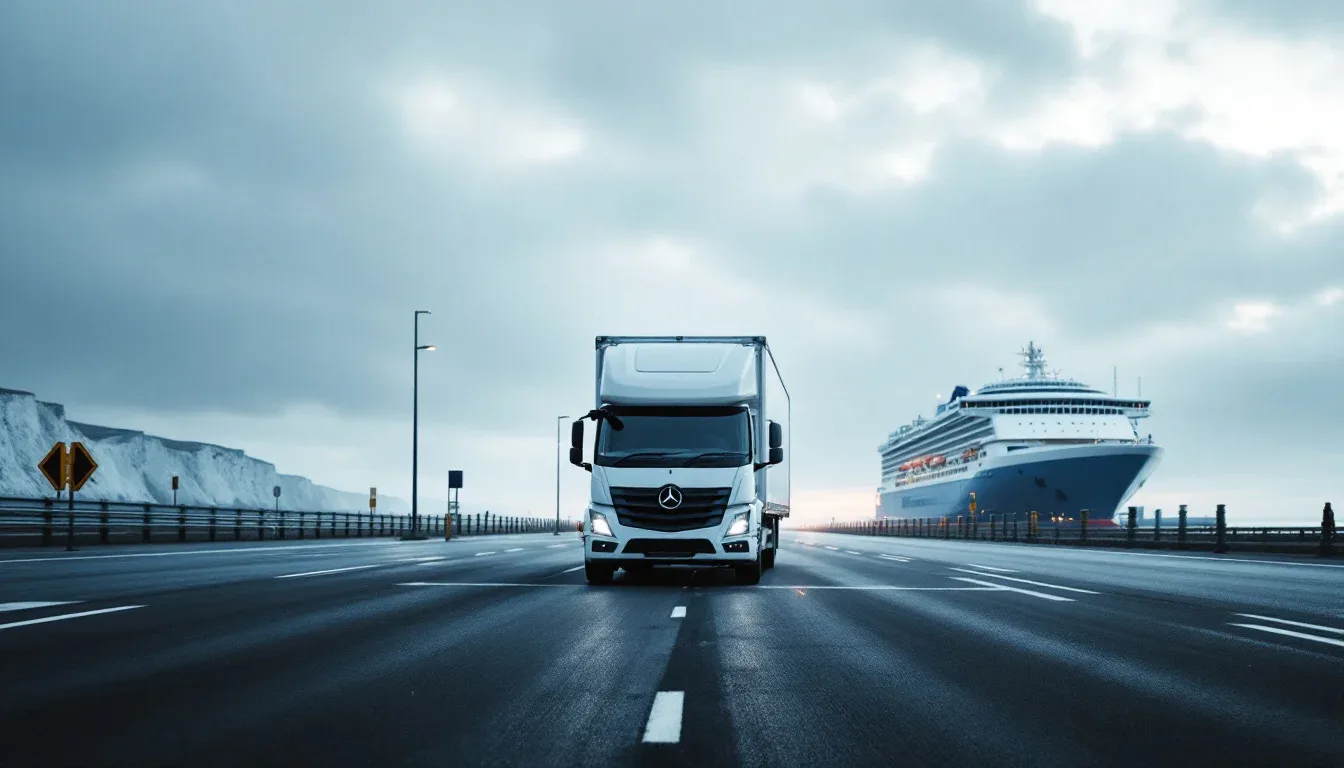
When a replacement gearbox has to reach a stalled production line near Stuttgart, or exhibition stock must be on a stand in Paris by Tuesday morning, an international parcel network is a gamble. A dedicated van courier to Europe works differently. One vehicle, one driver and one load travel from your premises straight to the delivery address abroad. This guide explains how the service works, what it typically costs and which customs paperwork UK exporters should have ready before the van leaves.
Quick answer: A dedicated van courier to Europe collects your goods in the UK and drives them door-to-door to Ireland, the EU, Norway or Switzerland in one vehicle, with the ferry crossing included. Nothing passes through sorting hubs, so there is less handling and delay. CourierFly prices start from £578, and you'll need export paperwork in place.
Key Takeaways
Your goods stay on one van with one driver from collection to delivery, with no parcel network or transhipment hub in between.
The ferry crossing is built into the price, so you get one fixed quote rather than a stack of extras.
CourierFly's international dedicated van service to Ireland, the EU, Norway and Switzerland starts from £578; final cost depends on distance, van size and route.
Since Brexit, every commercial shipment to Europe needs an EORI number, a commercial invoice and an export declaration, and often transit documents too.
Urgent, fragile, high-value or oversized goods benefit most; low-value boxed items with flexible deadlines rarely justify a private van.
How a dedicated van courier to Europe works
The idea is simple: you book the whole vehicle. A driver collects from your site, whether that's a factory unit in the Black Country, a warehouse off the M62 or an office in central London, loads your consignment and drives directly to the destination. There are no other collections on board, no depot stops and no trailer swaps. The same person who signed for your goods hands them over at the other end.
For UK businesses used to booking pallets or parcels, the main difference is accountability. On a shared network your shipment is one barcode among thousands, scanned at each hub. On a dedicated run there is a single vehicle to track and a single driver responsible for your load the whole way. CourierFly backs this with a 24/7 UK-based control room, tracking and photo proof of delivery, so you can tell your customer exactly where things stand.
From collection to the ferry
Once the booking is confirmed and the paperwork is ready, the van is dispatched to you. The driver checks the load against your packing list, secures it with straps or load bars, and heads for the port. Common crossings include Dover to Calais or Dunkirk for France, Belgium, Germany and beyond; Harwich to the Hook of Holland or Hull to Rotterdam for the Netherlands and northern Europe; and Holyhead to Dublin or Fishguard and Pembroke Dock to Rosslare for the Republic of Ireland. The crossing is included in the price, so you are not paying separately for tickets or route choice.
On the continent the van continues straight to the delivery address. For longer routes such as northern Italy, Spain or Scandinavia, operators may use two drivers so the vehicle keeps moving while legal rest requirements are respected. It's worth asking about this when you book, because it has a big effect on transit time.
Where the vans go
CourierFly runs dedicated vans to Ireland, every EU member state, Norway and Switzerland. That covers the industrial heartlands of Germany and northern Italy, the ports and distribution centres of the Low Countries, and the research clusters around Basel and Oslo. The fleet ranges from small vans to Luton vans with tail lifts, so the vehicle can be matched to anything from a single box of critical spares to a full load of exhibition kit. You can see how this sits alongside UK same-day and next-day work on the main CourierFly courier services page.
Why skipping parcel hubs reduces damage and delay
A typical international parcel can be handled many times on its way from Birmingham to Barcelona: collected into a local depot, trunked to a national hub, sorted, loaded onto a cross-Channel trailer, unloaded at a continental hub, sorted again and passed to a local delivery partner. Every one of those steps is a chance for a box to be dropped, crushed under heavier freight, misrouted or simply left on a cage overnight.
Fewer handling points, less damage
With a dedicated van, your goods are typically handled twice: loaded at collection and unloaded at delivery. That matters enormously for items that don't survive conveyor belts, such as calibrated instruments, glass, artwork, prototypes, display stands or electronics. It also means you can ship things a parcel network won't accept at all, including awkward shapes, unboxed machinery parts and items too heavy for standard parcel limits. Manufacturers moving tooling or line-side components to European plants often choose a dedicated van for exactly this reason, and our page on urgent manufacturing deliveries covers the sort of loads involved.
Security improves too. A sealed van with one driver and no stops at third-party depots gives far fewer opportunities for loss. For high-value consignments, CourierFly offers goods-in-transit insurance on every booking with enhanced cover options available at checkout, so you can match the cover to what you're actually sending.
Delays you avoid
Hub-based services run to fixed schedules. Miss the evening trunk and your parcel waits a day; hit a customs query at a continental hub and it may sit in a holding area while emails go back and forth. A dedicated van doesn't wait for a sort. It leaves when your goods are ready and travels at the pace of the road and the ferry timetable.
That doesn't make borders disappear. Since the EU's Entry/Exit System began rolling out in October 2025, drivers' passport checks at Dover and other ports can add time at busy periods, and customs problems will still stop a van. The difference is that a single dedicated driver, backed by a control room, can deal with a query immediately rather than your shipment joining a queue of exceptions.
What a dedicated van to Europe typically costs
CourierFly's international dedicated van service starts from £578, which reflects a shorter run such as the Republic of Ireland or northern France in a smaller vehicle. Across the UK market, typical figures for a dedicated small or medium van run roughly from £600 to £1,000 for France, Belgium and the Netherlands, £900 to £1,500 for Germany, Denmark or Switzerland, and £1,300 to £2,500 or more for southern Italy, Spain, Portugal or Scandinavia. These are broad market ranges, not fixed prices, and the instant quote is the figure that counts.
What drives the price
Distance is the biggest factor, because the van and driver are committed for the whole round trip, including the empty return. Vehicle size comes next: a Luton with a tail lift costs more than a small van but may save you a second vehicle. The ferry route, road tolls in France, Italy, Spain and Switzerland, overnight stays, a second driver for long runs and any waiting time at collection, delivery or customs all feed into the total.
Timing matters too. Weekend crossings, bank holidays and peak summer ferry demand can push costs up, while giving a little notice often helps. If you send regularly to the same European customers, a business credit account can make repeat bookings simpler to manage.
Getting a fixed quote
With CourierFly you enter collection and delivery postcodes on the booking page and see a price in seconds, with no hidden fees and no account required. Business clients can apply for a 30-day credit account. Because the ferry is included and the price is fixed at the point of booking, you can quote your own customer confidently without worrying about surcharges appearing on an invoice weeks later.
Customs paperwork UK exporters should prepare
This is where most European shipments go wrong. Since the UK left the EU single market and customs union, goods moving from Great Britain to the EU, Norway or Switzerland are exports and imports in the full customs sense. A dedicated van removes the parcel network, but it doesn't remove the paperwork. The government's step-by-step guide to exporting goods from the UK is the best starting point, and the essentials are below.
Before you book
First, you need a GB EORI number, which identifies your business to customs authorities; you can apply for an EORI number on gov.uk, usually within a few days. Your receiver in Europe will need an EU EORI number if they are importing. Next, work out the commodity code for each item, as this determines duty rates and any controls. Agree Incoterms with your customer, for example DAP (the buyer handles import clearance and duties) or DDP (you do), so everyone knows who pays what at the border.
Most businesses use a customs agent or freight forwarder to lodge declarations on HMRC's Customs Declaration Service and in the destination country. Talk to the team at CourierFly early about how clearance will be arranged for your shipment, so the van isn't booked before the documents are ready.
Document | What it does | Usually prepared by |
|---|---|---|
EORI number | Identifies exporter and importer to customs | Each business, via gov.uk or the EU state |
Commercial invoice | States goods, value, currency, Incoterms and commodity codes | Exporter |
Packing list | Lists contents, weights and dimensions per package | Exporter |
UK export declaration | Records the export with HMRC and generates an MRN | Customs agent or exporter |
Transit document (T1 / NCTS) | Lets goods travel under customs control to an inland clearance point | Customs agent |
Statement on origin | Claims zero tariff under the UK–EU Trade and Cooperation Agreement where goods qualify | Exporter, on the invoice |
Licences or certificates | Covers controlled, dual-use, food, plant or animal products | Exporter, with the relevant authority |
Norway, Switzerland and Ireland
Norway and Switzerland are outside the EU, so a van crossing France or Germany to reach them usually travels under common transit, with a transit declaration covering the EU leg before import clearance on arrival. Swiss deliveries in particular need declarations lined up in advance, as border offices can be strict about errors.
The Republic of Ireland is an EU member, so deliveries from Great Britain to Dublin, Cork or Galway need full export and import formalities. Northern Ireland is different, as it sits within the UK, and shouldn't be confused with an EU export. Temporary exports such as trade-show equipment or demonstration machinery may be better moved on an ATA Carnet, issued through the London Chamber of Commerce and Industry, which avoids paying import duty on goods that are coming home.
Which loads suit a dedicated European van
The service earns its cost when speed, care or certainty matter more than the cheapest possible rate. If a missing part is halting a production line or a customer is paying penalties for late delivery, the price of a private van is small by comparison.
Common business uses
Automotive suppliers send critical components to assembly plants across Germany, Spain and Central Europe; our automotive parts courier service is built around those tight deadlines. IT and data centre teams move replacement servers and network hardware that can't risk a conveyor drop, as covered on our IT spares delivery page. Event and exhibition firms use dedicated vans to deliver stands and stock straight to venues in Cologne, Milan or Amsterdam, then bring everything back afterwards.
Other regular loads include artwork and antiques for galleries and auction houses, prototypes heading to European test labs, and part-loads too large for a parcel service but too small to justify a full articulated lorry. Hazardous materials need specialist handling under ADR rules, so mention them at the quote stage.
When a parcel network is fine
Honesty helps here. If you're sending a robust, low-value box with no deadline, a shared international parcel service will usually be cheaper, and a dedicated van would be overkill. The dedicated option makes sense when the load is urgent, fragile, valuable, bulky or simply too important to leave to a hub-based schedule. For more practical advice on choosing between courier options, browse the CourierFly delivery guides.
Frequently Asked Questions
How long does a dedicated van to Europe take?
It depends on distance, the crossing and customs. Northern France, Belgium and the Netherlands are often reachable the same day or overnight from much of England, while Germany, Switzerland and Ireland typically take one to two days. Southern Europe and Scandinavia can take two to three days, faster with two drivers.
Is the ferry crossing included in the price?
Yes. CourierFly's dedicated van transport to Europe runs door-to-door with the ferry crossing included in the quoted price, so you aren't billed separately for the sea leg.
Do I need an EORI number to send goods to Europe?
Yes. Any business exporting commercial goods from Great Britain to the EU, Norway or Switzerland needs a GB EORI number. Your customer will normally need an EU EORI number to import the goods.
Can a dedicated van courier to Europe carry pallets?
Yes, within the vehicle's size and weight limits. Larger vans with tail lifts can take pallets, which is useful for part-loads that are too big for parcel networks but don't need a full lorry. Give accurate dimensions and weights when you book.
What happens if customs stops the van?
The driver reports the issue to the control room, which liaises with you and your customs agent to resolve it. Most stops come from missing or inconsistent paperwork, so checking that the invoice, packing list and declaration match before collection is the best prevention.
Moving goods to Europe doesn't have to mean handing them to a chain of hubs and hoping for the best. A dedicated van courier to Europe keeps your consignment on one vehicle, with one driver, from your door to your customer's. If you have urgent parts, valuable equipment or a load that simply has to arrive intact, get an instant quote from the team at CourierFly or explore our full range of UK and European courier options to find the right fit.
Need a courier?
International Courier to Ireland and the EU · Book a courier online · Call 0330 341 3180
Related guides
- Same Day Courier: How It Works, What It Costs and What to Have Ready
Guides · 25 October 2026 · 11 min read
How a same day courier collects within the hour and drives direct, what it costs in 2026 and what to have ready for a fixed-price quote. - How much does a same-day courier cost in the UK? (2026 guide)
Pricing · 24 September 2026 · 3 min read
A transparent 2026 breakdown of UK same-day courier pricing: what drives the cost, typical rates by van size and city pair, and how to keep your invoice predictable. - Same-day vs dedicated vs timed courier — which do you need?
Guides · 24 September 2026 · 2 min read
Same-day, dedicated and timed courier services are not the same thing. Here is when each one is right for your business — with worked examples.